

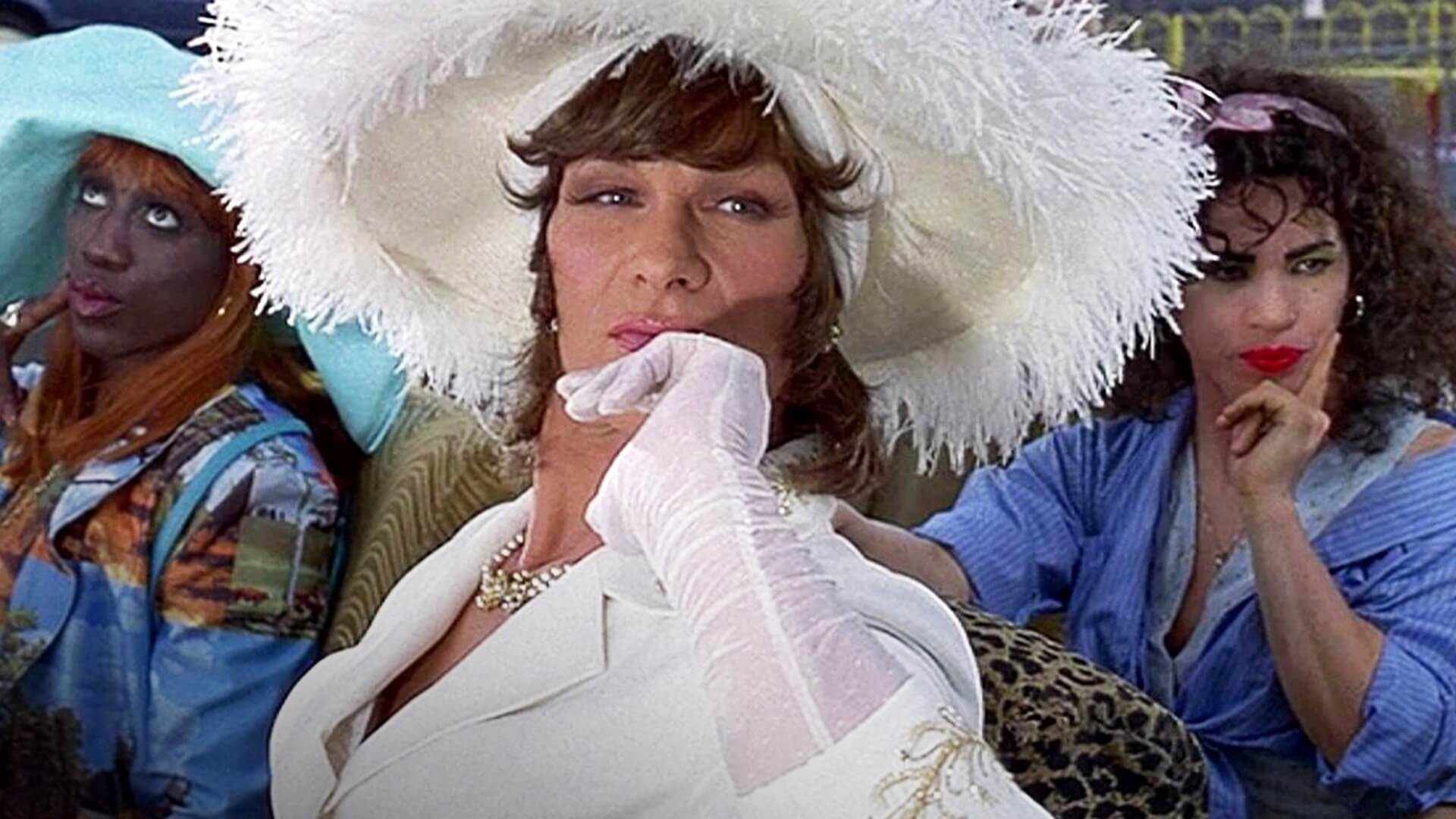
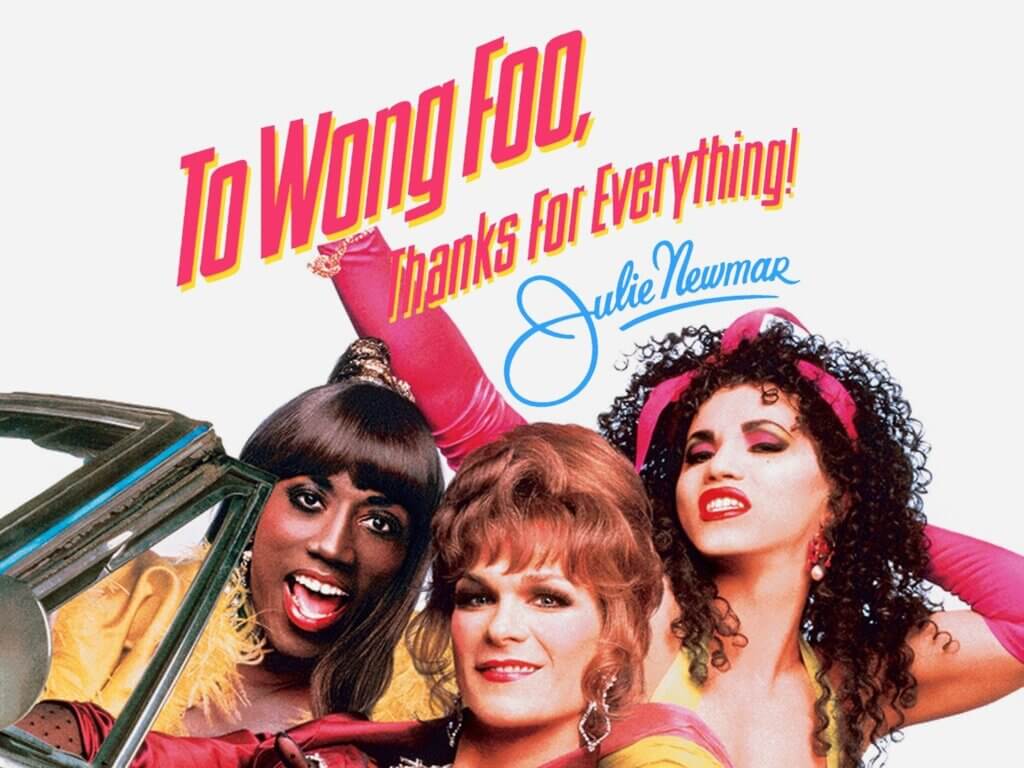
In To Wong Foo, Thanks for Everything! Julie Newmar, the glamorous New York City drag queens Vida Boheme, Noxeema Jackson, and Miss Chi Chi Rodriguez take small-town America in a storm of sequins, jewel tones, and false lashes. A cult classic, the 1995 film is credited as the first in Hollywood to tell a story centered around drag queens and drag culture. It even features a cameo by RuPaul (as the fabulously titrée Rachel Tensions), who has gone on to do so much to bring drag into the mainstream with the now-global phenomenon RuPaul’s Drag Race.
Although the storyline could be criticized as overly camp and saccharine, its determination to believe in the ability of goodness to vanquish ignorance and evil are key aspects of its charm. With its cross-country journey, To Wong Foo, Thanks for Everything! Julie Newmar unites the promise of the open road with the moral lessons of the fairytale, and it embraces itself as such while also subverting the genre’s tropes. The opening sequence showcases protagonists Vida and Noxeema’s process of transformation. Bare-faced and freshly showered, they go from blank canvas to perfectly manicured, coiffed, contoured works of art—no fairy godmother required. They remain as glorious as they are here for the rest of the film. When they tie for first place in a “Drag Queen of the Year” competition, they are topped with crowns, but they are not the wicked queens of Snow White or Alice in Wonderland. They are Cinderellas, the downtrodden and antagonized whose embrace of the transformative is empowering, and they use that power to do good.
And so it is that when Vida and Noxeema, still floating after their victory, encounter a crying fellow queen—or “princess”—in the stairwell, Vida takes pity on her and invites her to join their journey west. This act of generosity requires a sacrifice, and Vida and Noxeema must exchange their first-class plane tickets to Hollywood for another means of transport. When the used car salesman tries to convince them to opt for the sensible Toyota Corolla rather than the spiffy vintage Cadillac DeVille convertible, Vida poses the quintessential question: “Style or substance?” The question is moot not only because there can be no doubt about which vehicle the ladies will grace with their presence, but also because they don’t actually have to choose. They have both style and substance in spades; the car is just another accessory.
Like Cinderella, the ladies’ signifier is a lost shoe. Unlike Cinderella, however, they are not pursued by Prince Charming with an offer of marriage, but by Sheriff Dullard (hey, it’s how it’s written on his badge) armed with a rifle. Racist, sexist, predatory: Sheriff Dullard is the none-too-nuanced incarnation of evil here, but—alas—he is an all-too-recognizable figure.
As director Beeban Kidron noted, “When America coalesces around its values and energy, it’s a phenomenal place. An America that divides on those grooves, the social divergence, is a really ugly place. And that’s really what that movie was about.” The queens’ encounter with Dullard as well as their anxiety about where to sleep for the night highlight their position at the intersection of multiple forms of victimization. Miss Chi Chi’s walk to the “Drag Queen of the Year” competition at the film’s start, where she dodges insults and hurled bottles, introduces the precariousness of the queens’ positions within society, even in a place as diverse as New York City. While they reign within their own realm, in the United States of the 1990s, they remain outcast from the mainstream. Despite its general lightheartedness, the film is direct about the anguish the queens experience when it comes to what should be relatively simple interactions like finding a hotel room or stopping by one’s parents’ house.
The threat of violence because of their sexuality and identity is compounded by the threat of violence because they present as women. The film is direct here as well. Both Vida and Miss Chi Chi are nearly sexually assaulted, and Carol Anne faces mental and physical terror at the hands of her husband. While not all men in the film are bad—as Miss Chi Chi tells Bobby Ray, he is a “knight in a shining pickup truck”—enough are that the women expect very little from them.
When their chariot breaks down in the middle of nowhere, the ladies find themselves stranded in a place where the people are as dusty and simple as the town’s single dirt road. Within just a few days, they succeed in recreating Snydersville into something lively and colorful, helping its inhabitants to realize the latent dreams that live inside us all, old or young, bitter or innocent.
Just as Vida and Noxeema transform themselves at the start of the film, so they also transform the people of Snydersville into who they want to be.
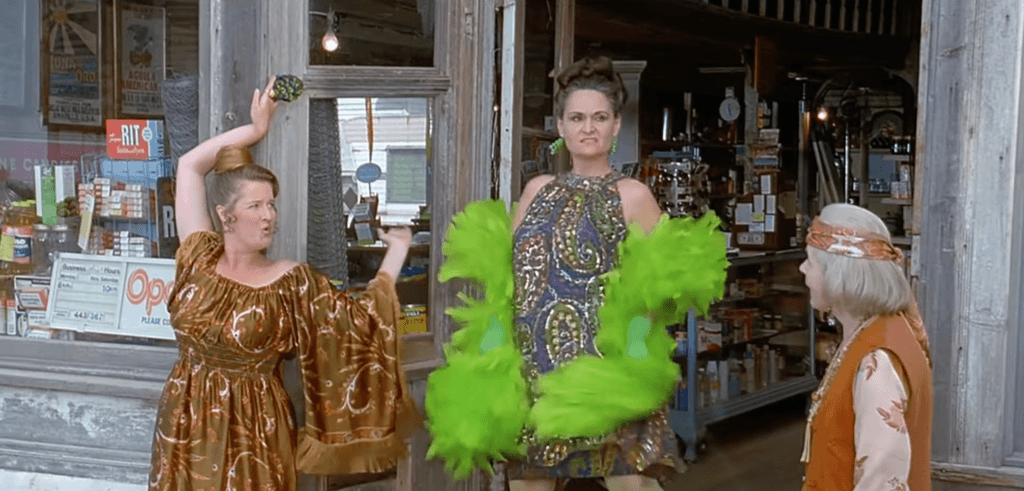
Questions of performativity and artifice often arise in discussions about gender. The protagonists of To Wong Foo, Thanks for Everything! Julie Newmar are obviously very intentional with their drag personas, but life is something we all have to do one way or another, and they choose the glamorous route. They embrace who they want to be and become it, unabashedly.
The women in Snydersville whom they guide through the makeover process, prior to their own transformation, are also performing. They are the personalities that have been accorded to them, as relayed by the town’s gossip, Beatrice (“Over there—her and husband ain’t had sex in nearly seven years”); they are the iterations of womanhood they are expected to be by the social norms of the place they are in (bad-boy Tommy refuses to concede that women merit his respect until Noxeema draws it to his attention); they are constrained by what others permit (“Some women just need to get hit,” Virgil says). The key difference between the queens and these “regular” women is that the queens are who they want, and they are making the most of the infinite spectrum of what life itself can be.
The film also does not shy away from realistic engagement with the social dynamics that condition how each character behaves. When Vida insists on intervening in Carol Anne’s relationship with her abusive husband Virgil, Miss Chi Chi calls her out as a “Freakazoid white lady telling the black lady and the Latin lady what to do” and an “oppressive gringa . . . running into people’s houses and bossing their lives around without them even asking.” Vida’s tendency to want to help can just as easily be perceived as an attempt to impose.
At the same time, Vida’s actions are more complex than a simple white savior narrative would imply. Her decisions to help instead of sitting back and doing nothing carry a personal cost. Just as the choice to offer Miss Chi Chi the opportunity to come to California requires Noxeema and Vida to give up their first-class tickets, Vida’s confrontation of Virgil risks exposing her identity. What’s more, Vida has advantages other characters do not that place her in a unique position to be able to help. Both Noxeema and Miss Chi Chi are the target of racial hatred, as emphasized in the slurs Sheriff Dullard hurls at them when he pulls their Cadillac over; to put themselves on the line in the same way as Vida carries a much higher potential cost. Carol Anne likewise cannot risk standing up to her husband because she is not strong enough to stop his fists. In short, Vida has physical and ethnic privileges she can use that other characters do not have access to.
When Sheriff Dullard finally tracks the queens down, it is Vida in particular who is in his crosshairs. The privileges that elsewhere have allowed her to intervene on others’ behalf exacerbate Dullard’s hatred for her. He experiences the weaponization of her privileges against his expectations as a betrayal, a threat to his worldview that must be eliminated; who Dullard thinks he is and who he wants to be cannot tolerate ambiguities. But Dullard underestimates the power of empowerment. The queens’ kindness, generosity, and zest for life have revitalized the town; their choice to do good has planted the seeds for others to do the same.
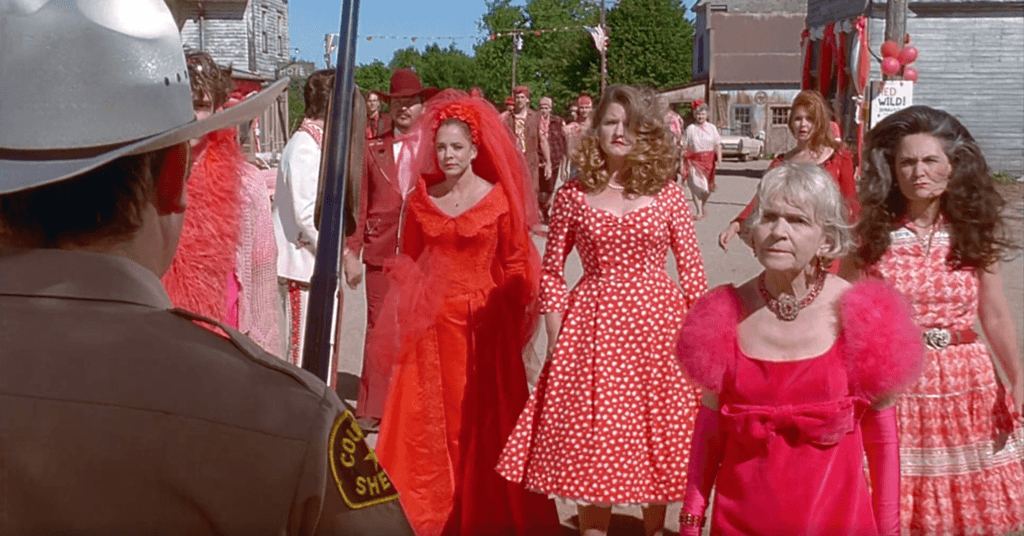
A statuesque figure in a flamboyant red dress, face obscured in red tulle, steps out to meet Dullard: it is an act of solidarity. Carol Anne knows that Dullard cannot easily harm her, and she exercises her own privilege within this situation to protect her friend, just as Vida has done for her. This is the fundamental aspect of privilege that should not be overlooked—it is relative, unfixed, highly dependent on context. The rallying of the town around Carol Anne reflects how deeply the queens’ presence has impacted its inhabitants as well as their awareness of their power. They stand together to drive Dullard off. Once the villain has been banished, they celebrate their strawberry social with style.
Life is more fun when you believe in yourself. Life is better for everyone when we believe in each other, too. The queens show Snydersville how to do that.
Related posts


Copyright © 2022 My Sunset by Bogdan Bendziukov.